
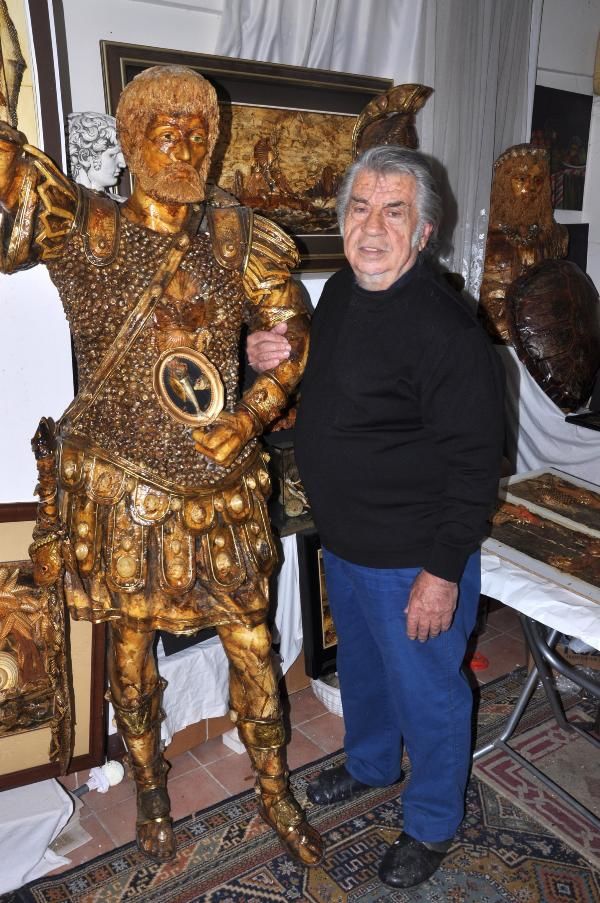
NEDIM CELKAN
1945 — 2025
Nedim Celkan (1 April 1945, Istanbul – 8 January 2025, Mugla) was a Turkish painter and diver known for creating artworks from marine life.
Born in Istanbul, Celkan began his visual art journey with cinema posters, print-house illustration and comic-book work, before gradually shifting his focus entirely to the sea and its creatures. Over the course of nearly sixty years of active diving, he personally collected fish, octopus, sea urchins, crabs, starfish, seaweed and various shells from the depths. These organic materials were then subjected to special chemical treatments, tanning processes and years-long drying and preservation stages, after which he transformed them into relief panels and three-dimensional sculptural works.
Mythology and marine culture occupy a central place in Celkan’s practice. His compositions frequently feature mermaids, mythological heroes, references to Neptune and Poseidon, Native American warriors, Egyptian figures, fish–human hybrids and underwater scenes.
In the final period of his life, Celkan lived in Datça, a coastal town in the province of Mugla. He never sold any of his works, choosing instead to preserve his entire oeuvre with great care. His greatest wish was for these extraordinary pieces to be seen and recognised across the world.
TIMELINE/
1945/
Born in Istanbul, Turkey (1 April).
1960s/
Begins diving as a young man; develops a lifelong fascination with marine life.
1960s–70s/
Works as a cinema poster painter, print-house illustrator, and comic-book artist.
Early 1980s/
Turns entirely toward the sea as his primary artistic source; begins collecting marine materials during dives.
Mid 1980s/
Creates his first relief works using real fish skins, shells, seaweed and marine fragments.
1990s–00s/
Establishes his signature visual language combining mythology and marine biology. Participates in approximately 95 exhibitions across major Turkish cities including Istanbul, Ankara, Izmir, Adana and Antalya.
2010s/
Continues producing large-scale reliefs and sculptural hybrid figures; refines long-term preservation techniques for organic materials.
Late 2010s/
Lives and works in Datça, Muğla; preserves his entire oeuvre without selling any works.
2025/
Passes away in Datça, Muğla, on 8 January, at the age of 79.
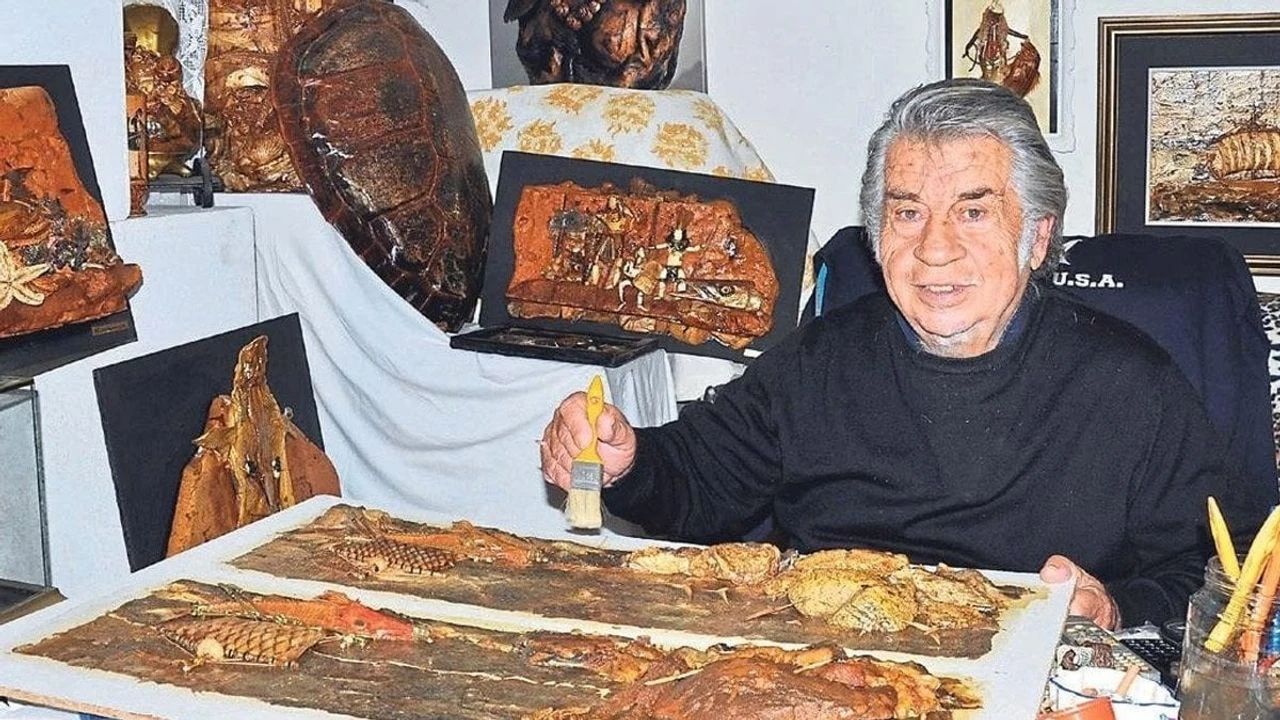
My life belongs to the sea. I am not only someone who eats fish, but someone who knows them, respects them, and listens to them. I wanted fish to have an art of their own. I have been diving for sixty years; I know the darkness, the light, the scent and the silence of the deep. Every creature that rises from the water speaks first to my curiosity, then to my imagination. Each fish carries a story, and through my art, I let those stories speak.”
My early years were spent painting cinema posters, working as a print-house illustrator, and drawing comic books. Those years taught me discipline, composition, and the art of creating character. Yet eventually, painting became insufficient. I felt a wall, a limit. The worlds drawn by my hand began to feel too narrow.
And at that very moment, the sea called me.
Whatever emerged from the water, I treated it as part of life itself.
Fish skins, wings, scales; crab arms; sea urchin shells; the texture of the octopus… I preserved each of them with special treatments, dried them for years, sometimes decades. Some materials required ten years of waiting; others twenty.
This is an art of patience. An art of devotion.
A single work may take months — or it may demand a lifetime.
Nothing you see in my works is accidental.
The sky may be the underside of a sole fish,
armour becomes moray skin,
a garment becomes the wing of a flying gurnard,
and the arm of a warrior may well come from a crab.
Mythology has always been close to me.
The daughters of Poseidon, Roman soldiers, Sioux warriors, Egyptian figures, fish–human hybrids…
They are the children of my imagination.
Beneath the waves, the silence always opened a doorway to another time.
I was the first to create this artistic language.
This is not a boast, but an observation. I know of no other artist who has worked with marine life on such a scale, with such discipline, and through purely organic materials. I wish there had been others — so that I might have learned from them as well. But this path opened itself only to me.
I never sold any of my works.
This is not an art made for money.
I kept every piece, protected them for years, because each of them was entrusted to me by the sea.
Toward the end of my life, I had only one wish:
That these works be seen around the world, recognised for what they are, and inspire others to dive into the sea and create new artistic languages of their own.
I can no longer dive, but my works still do.
They will continue to tell the stories that rise from the water.